By SGN | 28 Oct 2024

Wherever he goes, Winston wears his Southeast Asian identity with pride – often in the form of his signature batik shirts.
“I hate wearing suits,” says the Professor of Urban Climate at Singapore Management University. “And we’re from a region where batik is considered formal. It’s comfortable, and I’m happy to represent not just Singapore, but also Southeast Asia.”
It’s a wardrobe choice that has borne greater significance over the past year, as he is often attending international conferences, delivering keynotes on urban resilience, and meeting experts, policy makers and business leaders.
That’s because, in 2023, Winston made history as the first-ever Singaporean to be elected to the Bureau of the United Nations’ Intergovernmental Panel on Climate Change (IPCC) which is the United Nations’ leading scientific body.
It’s a weighty responsibility - literally
In the IPCC, Winston serves as co-chair of Working Group II, which leads the global assessment on how societies and ecosystems can adapt to the impacts of global warming. The other two working groups examine the science behind climate change (Working Group I) and reducing emissions (Working Group III). “It’s a weighty responsibility,” he says, “but one that I actually enjoy.”
The Panel’s work is hefty – literally. In its seventh assessment cycle, it entails generating the 7th Assessment Report (AR7), a hulking set of documents due by 2029 that Winston says, “governments are crying out for”. In AR6 (referring to the 6th assessment report, which happened in the last assessment cycle), Working Group II’s reports alone total three enormous volumes. “If you add in the reports of Working Groups I and III, the Synthesis Report, the three Special Reports, that’s 29kg in total,” he laughs.

And if that wasn’t enough, Winston’s Working Group is tasked with leading an important update of the 30-year-old climate adaptation guidelines and also a Special Report on cities – his personal area of expertise – due out in early 2027.
IPCC documents provide the gold standard of scientific information on climate change, one that holds sway among countries, especially when they negotiate for capital or technology needed for climate solutions, or if they need relevant information in areas lacking locally-based scientists who research on climate change. These reports are widely recognised as the most credible sources of information on climate change, which informs decision-making around the world.
The journey to co-chair
A lifelong academic, Winston says it was his brothers who spurred him to study climate with the pestering question, “Why is Singapore so hot?”.
During his Master’s at the National University of Singapore, he investigated the urban heat island effect. As a PhD candidate at Arizona State University, he researched microclimate modelling in cities. This was also when he first became involved with the IPCC, signing up as a reviewer of chapters for AR5.
In the IPCC’s sixth cycle, with Singapore’s backing, Winston became an author who developed several chapters related to cities and climate change. As an author, he was part of a team that had to respond to reviewers’ remarks from experts and governments. “Our urban chapter received more than 1,500 comments in total,” he recalls.
When the time came to nominate the next slate of leaders for the seventh cycle in 2022, Winston was asked if he was interested in running. “Several senior scientists and IPCC authors tapped me on the shoulder and said, ‘Hey, you did a pretty decent job as an author. People seem to like you and your work,’” he shares. “And AR7 was going to be a critical one because of the focus on cities.”

He consulted Singapore’s government, which was eager to throw their support behind him. “They sent out aide-memoires. They sent out people to encourage voting for me,” Winston says of the three-month campaign. “I made several trips to countries and spoke with a lot of ambassadors and scientists.”
Things came to a head in July 2023 in Nairobi, where 195 countries met at the United Nations Office and commenced a lengthy voting process via paper ballot.
While some positions went uncontested, Winston vied with four others for his Working Group II co-chair position. After an hour and a half of voting and tallying, he led with a solid 42% of the vote and proceeded into a runoff with another candidate. After another 90-minute period, the results were in: he had won with 70% of the votes.
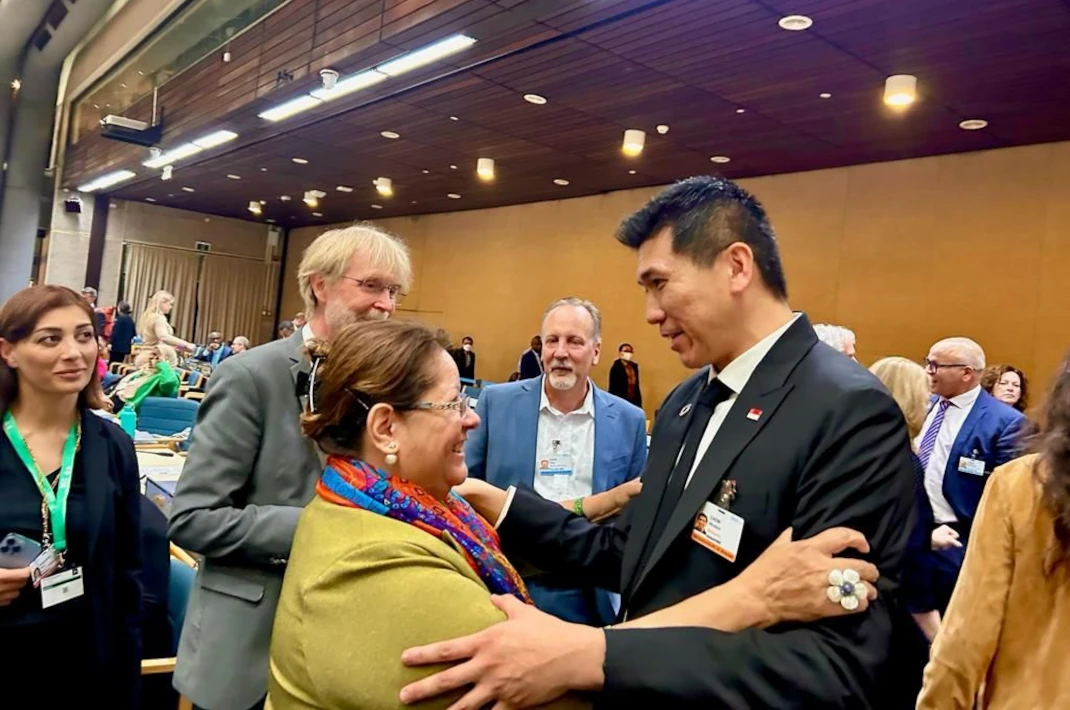
The hall erupted in applause. “There was lots of hugging,” he says, “and I lost count of the number of hands that I shook. After that, everything was a whirlwind – pictures taken, briefings, media interviews.”
The euphoria soon wore off, as he went into work mode. Along with fellow co-chair Bart van den Hurk of the Netherlands, Winston scrambled to rally support for excellent vice-chair candidates to round out the IPCC Bureau. “For three days, we approached delegates and pitched for candidates we hoped they would support,” he says. “We wanted to have the best team available to helm the important work in this assessment cycle.”
Navigating cultural differences to find common ground
Besides leading and coordinating the contributions of hundreds of top scientists and researchers from around the world, Winston engages with governments, NGOs and the private sector. He’s had to navigate social and cultural differences, as well as figure out how people of disparate backgrounds can work together.
“In my role, you have to be a people person, while knowing what is at stake and how climate change links to other disciplines,” he says. “It’s time-consuming and sometimes painful, because lots of disagreements occur.”
One trick he’s learned is to understand the other party’s interests and language and find out what makes them tick. For instance, discussing the importance of local voices and indigenous knowledge in climate resilience requires a different approach with climate activists, governments and the private sector.
Representing the IPCC, Winston offers governments and organisations policy-relevant proposals based on evidence compiled over decades. “The challenge with climate change now is no longer dealing with deniers or contrarians, but with people who don’t want to act on it,” he says.
“Climate change is a prisoner’s dilemma. If we want to get past this, we need to communicate and work together.”
“The solutions are there. The solutions are not new. The solutions do require, however, capital of different kinds, and for people to engage with each other.

Juggling work, life and travel
One year into his term, Winston describes the experience as a mix of excitement and exhaustion. “Seven years as Co-Chair is a long period. I’m getting comfortable with that,” he says.
At the Singapore Management University, he’s had to reduce his teaching load, an unfortunate compromise.
“It’s a pity. I tell people I like to ‘corrupt’ the minds of the youth – corrupt them into doing the right thing,” he jokes.
Still, he is thankful for collaborative colleagues and a Co-Chair that he gels with at IPCC. “I call Bart my brother from another mother. We think alike, we finish each other’s sentences, and our wives complain that we talk to each other more than we talk to them.”
Juggling work, home life and frequent travel, however, has been a significant challenge. “It’s a bit hypocritical,” he admits. “Air travel involves a lot of carbon emissions, but I see it as a necessary price to pay because at face-to-face meetings, we get so much more work done.”
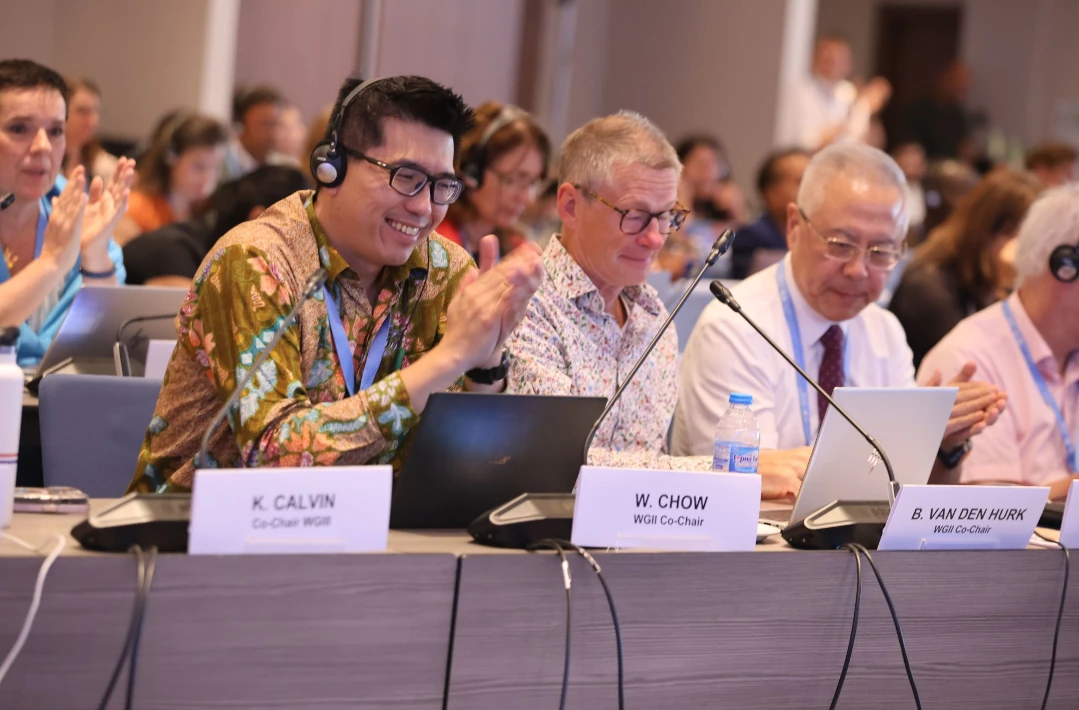
Winston’s team often reminds him to take time out to maintain his physical and mental health, be it weekends with family or football sessions with secondary school friends. Previously, he would fulfil his duties on work trips and hurry home. Now, he lingers a little and cherishes the opportunity to explore places like Riga, Latvia, where the last IPCC scoping meeting took place.
“Just spending an extra day there, walking around the city, talking to people, getting exposed to the culture, was a humbling experience,” he shares. “You learn that there’s so much of the world that you’ve yet to see and it reminds you that there’s so much in the world worth protecting.”
The world he’s leaving behind
As the world swelters and temperature records get broken again and again, Winston remains optimistic.
“Don’t get me wrong, emissions are still high,” he concedes. “And we are nowhere near a world of 1.5°C warming. However, before the Paris Agreement in 2015, we were on course for a 4°C world by the end of the century. The momentum for climate action since Paris is getting stronger and we’re on a course for a 2.7 °C world. Right now, because of the decarbonisation work going on globally, I believe we are at a point where emissions are going to peak soon, if they’ve not already peaked.”
He points out that countries like Singapore,with its Singapore Green Plan 2030, can see the way to climate resilience that the IPCC has said is an effective path forward for comprehensive decarbonisation and risk reduction. Singapore is also diversifying our energy sources, implementing a carbon tax, and transitioning professionals from carbon-intensive industries to emerging industries such as carbon capture storage and hydrogen.
“We’ve got a great ecosystem of climate research, we are very strong in green finance, and we have a reputation of being at the forefront of technology,” he says.

Elsewhere in the world, Winston notes how China, the world’s biggest economy, is taking the lead in renewable energy generation. The United Kingdom has likewise pivoted towards gas and renewables, and just shut down its last remaining coal-fired power plant in October 2024. And last year Portugal’s grid was entirely powered by renewable energy for six days.
Some have called 2024 the year of a polycrisis – a perfect storm of regional conflicts, economic turmoil, extreme weather, and high-stakes elections. For Winston, despite the hurdles, the work carries on. “I’m optimistic that the world I’m leaving behind for my two children will be good,” he says.

Meet Winston
Winston is Working Group II co-chair at the Intergovernmental Panel on Climate Change, the first Singaporean to be elected to the leadership Bureau of this UN body. He is also Professor of Urban Climate at Singapore Management University and part of the team that set up its College of Integrative Studies.
Connect with him here.